
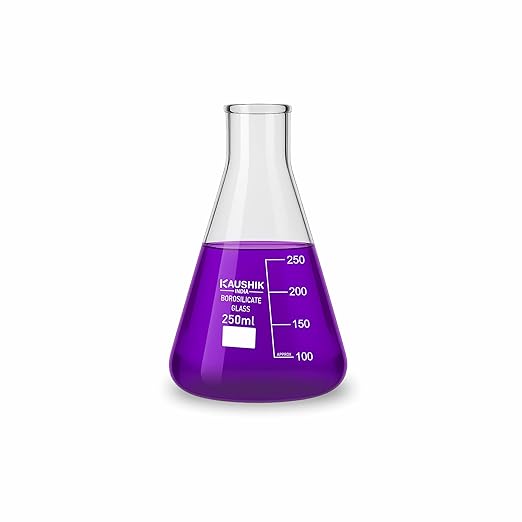
This 250ml school chemistry flask, made from high-quality borosilicate glass with a narrow mouth, is durable &, heat-resistant.
“Borosilicate Glass Round Bottom Boiling Flask with Inter Changeable Joint. 50 ML Capacity. Distillation Flask” has been added to your cart. View cart
KAUSHIK INDIA Borosilicate Glass Conical Flask,250ml Capacity narrow mouth for storage liquid Chemical school, college, chemistry lab, Laboratories
₹199.00 – ₹569.00Price range: ₹199.00 through ₹569.00
SKU: N/A
Categories: laboratary glassware, Scientific Instruments
Description
The Essential Guide to the School Chemistry Flask: A Foundation for Scientific Learning
Introduction to the School Chemistry Flask
A School Chemistry Flask is a fundamental piece of laboratory glassware used in educational settings. It is specifically designed to introduce students to basic chemical principles and procedures. The School Chemistry Flask is a durable and safe version of professional laboratory equipment. Its primary role is to facilitate hands-on learning in the science classroom.
These flasks are engineered for safety and student use. They are typically made from materials that can withstand rough handling. The School Chemistry Flask comes in various shapes, each with a specific teaching purpose. Common types include the Erlenmeyer flask, beaker, and test tube.
The School Chemistry Flask is a student’s first encounter with professional lab equipment. It teaches proper handling, measurement, and experimental technique. Using a School Chemistry Flask helps bridge the gap between theory and practice. It makes abstract chemical concepts tangible and exciting for young learners.
This flask is a symbol of scientific exploration in schools worldwide. It is an indispensable tool for fostering a love of chemistry and inquiry-based learning. The School Chemistry Flask is the cornerstone of any effective science curriculum.
What is a School Chemistry Flask? A Detailed Definition
A School Chemistry Flask is a type of laboratory vessel designed for educational use. It is a simplified and ruggedized version of flasks used in professional labs. The School Chemistry Flask is built to be safe, affordable, and durable for student handling. It is a key component of any school chemistry lab inventory.
These flasks are used to contain, mix, heat, and measure chemicals during experiments. They are scaled down in size to suit student workstations. The School Chemistry Flask often has thick walls to prevent breakage. It may also have reinforced rims for added safety.
The primary purpose of a School Chemistry Flask is educational. It allows students to perform classic chemistry experiments safely. Through its use, students learn fundamental lab skills. These skills include pouring, measuring, heating, and observing chemical reactions.
A School Chemistry Flask is more than just a container. It is an educational instrument that brings textbook diagrams to life. It is the practical tool through which students experience the scientific method firsthand.
The Anatomy of a School Chemistry Flask: A Component Breakdown
The Body: The Main Container
The body of a School Chemistry Flask is its primary containment area. It holds the liquids or solids used in an experiment. The shape of the body varies depending on the type of flask. For example, an Erlenmeyer flask has a conical body, while a Florence flask has a round body.
The body is designed to be robust. It often has thicker glass or is made from shatter-resistant plastic. This durability is essential for a School Chemistry Flask that will be used by many students. The body must withstand accidental bumps and knocks.
The size of the body determines the flask’s capacity. School Chemistry Flask sizes are typically small, such as 50ml, 100ml, or 250ml. This is suitable for the small-scale experiments conducted in classrooms. The body is where the chemical reaction or process visually occurs for the student.
The Neck: The Access Point
The neck of a School Chemistry Flask is the narrow section above the body. It serves as the channel for adding reagents and pouring out contents. The neck is often reinforced to prevent chipping. This is a common area of wear on a School Chemistry Flask.
On some flasks, the neck may be graduated with volume markings. This turns the School Chemistry Flask into a basic measuring tool. The neck also provides a safe place for students to grip the flask. It keeps their hands away from the body, which may be hot or contain chemicals.
The design of the neck controls pouring and reduces spills. This is an important safety feature for a School Chemistry Flask. A well-designed neck helps students learn proper pouring techniques.
The Base: For Stability and Safety
The base of a School Chemistry Flask is designed for maximum stability. A flat bottom is most common, allowing the flask to stand securely on a bench. This stability is crucial when students are adding chemicals or taking measurements. A stable School Chemistry Flask prevents accidental tipping.
The base is often slightly weighted or thickened. This lowers the center of gravity, making the flask less likely to tip over. For a School Chemistry Flask, a wide, flat base is the safest design. It provides a reliable foundation for student experiments.
Some flasks, like round-bottom flasks, cannot stand on their own. These are used with special clamps and stands in a school chemistry lab. However, the most common School Chemistry Flask types all have stable, flat bases.
The Rim: Reinforced for Safety
The rim of a School Chemistry Flask is a critical safety feature. It is the point where students pour from and where beakers may contact each other. For this reason, the rim is often reinforced or fire-polished. A fire-polished rim is smooth and rounded, eliminating sharp edges.
This reinforcement prevents chipping and cracking. A chipped rim can be sharp and may lead to the flask breaking completely. A strong, smooth rim is a key attribute of a quality School Chemistry Flask. It ensures the flask remains safe through years of student use.
The Critical Role of Material: Safety and Durability
Borosilicate Glass for School Use
Many School Chemistry Flasks are made from borosilicate glass. This type of glass has excellent thermal shock resistance. It can withstand sudden temperature changes without cracking. This is vital when students are learning to heat liquids safely.
Borosilicate glass is also highly chemical resistant. It won’t react with the acids, bases, or other chemicals used in school chemistry experiments. This ensures the purity of the experiment and the safety of the students. A glass School Chemistry Flask provides a clear view of the contents.
The durability of borosilicate glass makes it ideal for educational use. While not unbreakable, it is much stronger than ordinary glass. A School Chemistry Flask made from this material is a long-lasting investment for any science department.
Polystyrene and Polypropylene Plastic Flasks
Plastic School Chemistry Flasks are common in younger grades or for specific experiments. They are made from materials like polystyrene (PS) or polypropylene (PP). The biggest advantage of a plastic School Chemistry Flask is its shatterproof nature.
This makes it incredibly safe for student use. There is no risk of broken glass or sharp edges. Plastic flasks are also lightweight and inexpensive. This allows schools to equip large classes without a huge budget.
However, plastic School Chemistry Flasks have limitations. They are not suitable for heating and have lower chemical resistance. They are best used for cold experiments, measurements, or demonstrations.
Safety-Coated Glass Flasks
Some School Chemistry Flasks feature a special plastic safety coating. This coating is applied to the outside of a glass flask. If the glass breaks, the coating contains the fragments. This prevents shattered glass from scattering and causing injury.
A safety-coated School Chemistry Flask offers the best of both worlds. It has the chemical and heat resistance of glass. It also has the added safety of a plastic containment layer. This type of flask is highly recommended for busy school chemistry labs.
Types of School Chemistry Flasks and Their Educational Uses
The Erlenmeyer Flask: The Icon of the Lab
The Erlenmeyer flask is one of the most recognizable School Chemistry Flasks. Its conical shape and narrow neck make it perfect for mixing. Students use it for titrations, growing cultures, and storing solutions. Its shape allows for easy swirling without spilling.
The Erlenmeyer flask is a staple in the school chemistry lab. It teaches students about efficient mixing and containment. Its stable base makes it safe for use on student lab benches.
The Beaker: The Multi-Purpose Workhorse
The beaker is perhaps the most versatile School Chemistry Flask. Its cylindrical shape with a spout makes it ideal for pouring and mixing. Students use beakers for everything from preparing solutions to holding water baths.
A school chemistry lab is incomplete without a set of beakers. They are used in countless experiments and demonstrations. The beaker teaches students about volume estimation and liquid handling.
The Round Bottom Flask: For Advanced Setups
The round bottom flask is used for more advanced school chemistry experiments. It is designed for uniform heating and is used in distillation setups. Students learn about complex apparatus assembly with this flask.
Its use introduces students to professional laboratory techniques. The round bottom flask is typically used with a heating mantle and clamps. It demonstrates the importance of specialized glassware for specific tasks.
The Volumetric Flask: For Precision
The volumetric flask teaches students about precision and accuracy. It has a single graduation mark for preparing solutions of exact concentration. Students learn the importance of meticulous measurement in chemistry.
Using a volumetric flask is a key skill in quantitative analysis. It is an essential School Chemistry Flask for any course involving solution preparation.
The Florence Flask: For Boiling and Distillation
The Florence flask has a round body and a long neck. It is historically used for boiling and distillation. In the school chemistry lab, it is often used in distillation experiments.
It demonstrates how shape relates to function in laboratory design. The Florence flask shows students a different approach to containing and heating liquids.
Key Specifications for Selecting a School Chemistry Flask
Capacity and Size for Student Use
School Chemistry Flasks come in a range of capacities. Small sizes (50ml, 100ml) are ideal for individual student work. Larger sizes (250ml, 500ml) are better for group work or teacher demonstrations. Choosing the right size is crucial for managing chemicals safely.
Smaller flasks use less reagent, which is more cost-effective and safer. They are also easier for students to handle. The capacity should match the scale of the intended experiments.
Durability and Safety Features
Durability is the most important specification for a School Chemistry Flask. It must withstand daily use by multiple students. Look for features like reinforced rims, thick walls, and safety coatings.
The flask should be designed to minimize breakage and injury. Safety must be the top priority when selecting equipment for a school chemistry lab.
Chemical and Heat Resistance
The School Chemistry Flask must be compatible with the chemicals used in the curriculum. Borosilicate glass offers the best all-around resistance. If heating is required, the flask must be able to withstand the intended temperatures.
Always check the manufacturer’s specifications for chemical and temperature limits. This ensures the flask is suitable for its intended educational use.
Clarity and Graduation Marks
Good optical clarity is important for a School Chemistry Flask. Students need to see color changes, precipitates, and liquid levels. Some flasks have graduation marks for approximate volume measurements.
These marks help students learn about measurement and estimation. Clear, durable markings are a valuable feature on an educational flask.
Primary Applications in the School Curriculum
Basic Mixing and Reaction Observations
The most fundamental use of a School Chemistry Flask is for mixing chemicals. Students can observe reactions like acid-base neutralization or precipitation. The flask provides a safe container for these reactions.
This hands-on experience is far more impactful than reading about reactions. The School Chemistry Flask makes chemistry real and engaging for students.
Heating and Evaporation Experiments
Students learn about phase changes and evaporation using a School Chemistry Flask. They can safely heat water to boiling or evaporate a solution to dryness. These experiments teach important concepts about energy and states of matter.
The flask‘s heat-resistant properties make these demonstrations possible. Students learn proper heating techniques under supervision.
Measurement and Solution Preparation
School Chemistry Flasks with graduation marks teach students about measurement. They learn to estimate volumes and prepare simple solutions. This introduces the concept of concentration and dilution.
These skills are fundamental to all quantitative chemistry. The School Chemistry Flask is the perfect tool for introducing these concepts.
Titration and Quantitative Analysis
In advanced high school courses, flasks are used for titrations. The Erlenmeyer flask is ideal for this purpose. Students learn about stoichiometry and analytical techniques.
This application shows how laboratory equipment is used for precise measurements. It prepares students for college-level laboratory work.
Proper Usage and Safety Protocols for Students
Handling and Transporting Flasks
Students should be taught to always handle a School Chemistry Flask with care. They should use both hands when carrying a flask, especially if it contains liquid. One hand should support the base while the other steadies the neck.
Flasks should never be carried by the neck alone. This can lead to dropping and breakage. Proper handling techniques should be demonstrated and practiced.
Heating and Cooling Procedures
When heating a School Chemistry Flask, students must use safety goggles and heat-resistant gloves. The flask should be heated gradually to avoid thermal shock. It should never be placed on a cold surface immediately after heating.
Students should learn to point the flask away from themselves and others when heating. These safety protocols are essential for preventing accidents.
Pouring and Mixing Techniques
Proper pouring technique is a key skill taught with a School Chemistry Flask. Students should use a stirring rod to guide the liquid and prevent splashing. The flask should be swirled gently rather than shaken violently.
Liquids should be poured slowly and carefully. These techniques minimize spills and exposure to chemicals.
Cleaning and Maintenance of School Flasks
Routine Cleaning After Experiments
School Chemistry Flasks should be cleaned immediately after each use. Students should rinse them with water first, then wash with a mild detergent. A bottle brush can be used for the inside of the flask.
A final rinse with distilled water will prevent water spots. Clean flasks should be dried upside down in a rack.
Storage and Organization
Proper storage extends the life of School Chemistry Flasks. They should be stored in a dedicated cabinet with adequate padding. Flasks should not be stacked inside each other, as this can cause them to become stuck.
A well-organized storage system makes it easy to inventory and access the flasks. It also reduces the risk of breakage during storage.
Regular Inspection for Damage
School Chemistry Flasks should be inspected regularly for chips, cracks, or scratches. Damaged flasks should be removed from service immediately. Even a small chip can weaken the glass and lead to breakage.
A regular inspection schedule ensures that only safe equipment is used by students. This is a critical part of lab management.
The Future of School Chemistry Flasks
Innovations in Safety Materials
Future School Chemistry Flasks may be made from new, safer materials. Advanced polymers could offer glass-like clarity with even greater shatter resistance. These innovations will make chemistry labs safer for students.
Digital Integration and Smart Flasks
While traditional flasks will always have a place, digital integration is possible. School Chemistry Flasks with embedded sensors could measure temperature or pH. This would allow students to collect digital data directly from their experiments.
Sustainable and Eco-Friendly Designs
As sustainability becomes more important, School Chemistry Flasks may be made from recycled materials. Biodegradable plastic flasks could be used for certain applications. This would reduce the environmental impact of science education.
Conclusion: The Foundation of Science Education
The School Chemistry Flask is more than just a piece of glassware. It is a fundamental tool for science education. It provides the hands-on experience that makes chemistry come alive for students.
Through its use, students learn not only chemistry but also responsibility and safety. The School Chemistry Flask is a symbol of inquiry and discovery. It represents the practical side of scientific learning.
A well-equipped school chemistry lab with quality flasks is essential for effective science education. It prepares the next generation of scientists, doctors, and engineers. The humble School Chemistry Flask plays a vital role in shaping our technological future.
Additional information
| Packs | Pack of 1, Pack of 2, Pack of 6 |
|---|
Be the first to review “KAUSHIK INDIA Borosilicate Glass Conical Flask,250ml Capacity narrow mouth for storage liquid Chemical school, college, chemistry lab, Laboratories” Cancel reply
Related products
-
Sale!
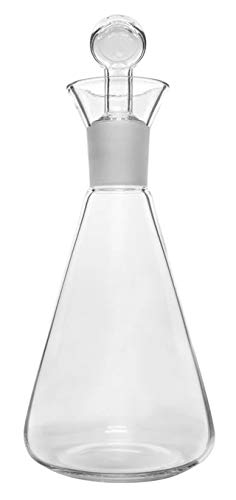
Iodine Flask With Glass Stopper 500ml. Iodine Flask for Lab
₹899.00Original price was: ₹899.00.₹499.00Current price is: ₹499.00. -
Sale!

KAUSHIK INDIA BOROSILICATE GLASS 3.3 SEPARATING FUNNEL 250ML WITH GLASS STOPCOCK
₹1,191.00Original price was: ₹1,191.00.₹463.00Current price is: ₹463.00. -
Sale!
Witeg Borosilicate Glass Coil Condenser with 24/29 Joint Jacket Length – 200 mm || Coil Condenser | Condernsor For Distillation Assembly ||
₹999.00 – ₹2,229.00Price range: ₹999.00 through ₹2,229.00Select options This product has multiple variants. The options may be chosen on the product page Details
Reviews
There are no reviews yet.