
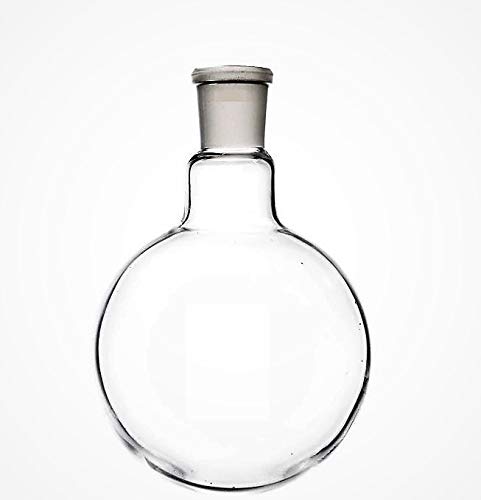
This 2000ml round bottom flask with B-24 joint is made from durable glass, ensuring heat resistance and reliability for laboratory heating, boiling.
Round Bottom Flask 2000 ML With joint b-24
Original price was: ₹1,159.00.₹659.00Current price is: ₹659.00.
Description
The Essential Guide to the Round Bottom Flask: The Workhorse of Chemical Synthesis
Introduction to the Round Bottom Flask
A Round Bottom Flask is a fundamental piece of laboratory glassware. It is characterized by its spherical body and a long, narrow neck. This iconic laboratory flask is a staple in chemistry labs worldwide. Its primary use is for heating, boiling, and distilling liquids under controlled conditions.
The unique spherical shape of the round bottom flask is not arbitrary. It is engineered for efficiency and safety. This design allows for uniform heat distribution when placed in a heating mantle. The round bottom flask is indispensable for a wide range of chemical procedures.
It is most commonly associated with organic synthesis and distillation setups. The round bottom flask can withstand vigorous boiling and stirring without cracking. This makes it superior to flat-bottomed vessels for heating applications. Its design minimizes sharp corners where stress can concentrate.
The round bottom flask is typically made from borosilicate glass. This material provides excellent thermal shock resistance. This heat resistant property is crucial for its function. Understanding the round bottom flask is key to understanding modern chemistry.
What is a Round Bottom Flask? A Detailed Definition
A Round Bottom Flask is a type of laboratory flask with a spherical body. It is designed specifically for applications involving heating and evaporation. The spherical shape is the defining feature of this chemical reaction flask. It is also known as a boiling flask or a reaction flask.
The neck of the round bottom flask is where attachments are connected. Standard taper ground glass joints are common on these flasks. These joints allow for a secure, leak-proof connection to other glassware. The round bottom flask is a core component of modular laboratory setups.
Its capacity can range from 50 milliliters to 20 liters or more. The size chosen depends on the scale of the reaction or distillation. The round bottom flask is not designed to stand upright on its own. It requires support from a clamp and a stand, or a heating mantle.
This flask is a versatile tool for chemical reactions, distillations, and refluxing. The round bottom flask is a symbol of chemical experimentation and process chemistry.
The Anatomy of a Round Bottom Flask: A Component Breakdown
The Spherical Body: The Core Reaction Chamber
The spherical body is the main feature of the Round Bottom Flask. This shape provides the largest possible internal volume for a given surface area. It allows for efficient mixing and boiling of liquids. The contents can be swirled without fear of splashing.
The spherical shape ensures uniform heat distribution. When placed in a heating mantle, heat is applied evenly across the entire bottom surface. This prevents the formation of local hot spots. These hot spots could lead to decomposition of sensitive compounds.
The body of the round bottom flask is where the chemical reaction takes place. It is the primary container for the reaction mixture. The reaction flask must be inert and resistant to the chemicals inside.
The Neck: The Conduit for Connections
The neck of the Round Bottom Flask is a cylindrical extension from the body. It serves as the access point for adding reagents and connecting apparatus. The length and diameter of the neck are standardized. Most round bottom flasks have a single neck.
However, multi-neck round bottom flasks are also common. A two neck round bottom flask allows for multiple attachments. A three neck round bottom flask offers even greater flexibility. Additional necks can accommodate a condenser, thermometer, or addition funnel.
The neck is often where the ground glass joint is located. This joint is critical for creating an airtight system. The neck must be strong enough to support the weight of attached components.
The Ground Glass Joint: For Secure Sealing
The ground glass joint is a key feature of modern round bottom flasks. It consists of a precision-ground frosted glass surface. This mates with a corresponding joint on another piece of glassware. The joint is typically secured with a plastic clip or keck clamp.
This system creates a secure, vacuum-tight seal. It is far superior to older cork or rubber stopper methods. The ground glass joint allows for the easy assembly of complex apparatus. Standard sizes like 14/20, 19/22, and 24/40 ensure compatibility.
The joint on a round bottom flask is usually a female joint. This allows male joints from condensers or other components to be inserted. The quality of the grinding is essential for a good seal.
Why Material Matters: The Borosilicate Glass Advantage
Superior Thermal Shock Resistance
Borosilicate glass is the standard material for a Round Bottom Flask. Its most important property is thermal shock resistance. This heat resistant quality allows the flask to withstand rapid temperature changes. A round bottom flask can be heated to high temperatures and then cooled without cracking.
This is due to the low coefficient of thermal expansion of borosilicate glass. It expands very little when heated. This property is essential for a boiling flask used in heating mantles. Ordinary glass would shatter under such stress.
Excellent Chemical Resistance and Inertness
A Round Bottom Flask must contain aggressive chemicals. Borosilicate glass is highly chemical resistant. It is inert to most acids, bases, and organic solvents. This ensures that the reaction flask does not contaminate the reaction mixture.
The purity of the reaction is maintained inside the glass flask. No leaching of ions or other contaminants occurs. This chemical resistance is vital for achieving reproducible results in synthesis.
Mechanical Durability for Demanding Use
While still glass, borosilicate glass is remarkably durable. It has good resistance to mechanical shock and abrasion. A high-quality Round Bottom Flask can withstand the rigors of daily laboratory use. Its durable nature ensures a long service life.
The spherical shape also contributes to its strength. It distributes mechanical stress more evenly than angular shapes. This makes the round bottom flask a robust piece of equipment.
Clarity for Visual Monitoring
The transparency of borosilicate glass is a significant advantage. It allows the chemist to visually monitor the reaction inside the flask. Changes in color, consistency, or phase can be observed in real-time. This is crucial for controlling reaction progress.
The clarity of the round bottom flask provides immediate feedback. It is an essential tool for observational chemistry. The transparent nature of the flask is a key feature.
Types of Round Bottom Flasks: A Comprehensive Overview
Single Neck Round Bottom Flasks
The single neck round bottom flask is the most basic type. It features one neck with a ground glass joint. It is used for simple reactions, distillations, and evaporations. This flask is a fundamental and versatile piece of glassware.
It is ideal for setups where only one attachment is needed. For example, connecting directly to a condenser for distillation. The single neck flask is the most common type found in laboratories.
Two Neck Round Bottom Flasks
A two neck round bottom flask offers increased functionality. The second neck allows for the simultaneous addition of a reagent and monitoring of temperature. One neck can hold a condenser for reflux, while the other holds an addition funnel.
This design is essential for reactions that require controlled addition of reactants. The two neck round bottom flask is a standard for more complex synthetic procedures.
Three Neck Round Bottom Flasks
The three neck round bottom flask provides maximum flexibility. It is the preferred choice for sophisticated reaction setups. The three necks can accommodate a condenser, thermometer, and addition funnel simultaneously.
This allows for precise control over reaction parameters. A three neck round bottom flask is essential for advanced organic synthesis. It is the ultimate reaction flask for complex chemical transformations.
Multi-Neck and Specialty Flasks
Round bottom flasks with four or more necks are available for specialized applications. Some flasks have angled necks or specific joint configurations. These specialty flasks are designed for specific types of apparatus or reactions.
Their design is tailored to meet unique experimental requirements. These multi-neck flasks are used in research and development laboratories.
Key Specifications for Selecting a Round Bottom Flask
Capacity: Choosing the Right Size
Round Bottom Flasks come in a wide range of capacities. Common sizes include 50ml, 100ml, 250ml, 500ml, 1000ml (1L), 2000ml (2L), and 5000ml (5L). Selecting the correct capacity is critical for reaction efficiency and safety.
A good rule is to fill the flask to no more than half or two-thirds of its capacity. This provides sufficient headspace to prevent boiling over. The right size round bottom flask ensures optimal performance.
Joint Size and Type: Ensuring Compatibility
The ground glass joint size is a crucial specification. Standard sizes are 14/20, 19/22, and 24/40. The first number is the diameter in millimeters at the wide end. The second number is the length of the joint in millimeters.
It is essential that all components in an apparatus have matching joint sizes. The joint type (e.g., female) must also be compatible. Proper matching ensures a secure and vacuum-tight seal for the reaction flask.
Glass Thickness and Quality
The quality of the borosilicate glass is paramount. The glass should be free of bubbles, stones, and streaks. The wall thickness should be uniform throughout the round bottom flask. This ensures even heat distribution and mechanical strength.
A high-quality flask will have a fire-polished rim on the neck. This indicates careful manufacturing and adds to the durability of the glassware.
Primary Applications and Uses of the Round Bottom Flask
Chemical Synthesis and Reaction Vessel
The primary use of a Flask is as a reaction flask. It is the container where chemical reactions are carried out. Its heat resistant nature allows it to be heated directly. It can withstand vigorous stirring and boiling.
From simple esterifications to complex multi-step syntheses, the flask is central. It is the heart of the organic chemistry laboratory. The reaction flask is where molecules are transformed.
Distillation: Simple and Fractional
The Flask is the standard pot for distillation setups. In simple distillation, it holds the liquid mixture to be boiled. The vapor travels from the flask to a condenser. The spherical shape is ideal for even boiling.
In fractional distillation, the serves the same purpose. It is an essential component of any distillation apparatus. The boiling flask is a key to separation and purification.
Refluxing for Controlled Reactions
Reflux is a common technique for reactions that require prolonged heating. A is connected to a vertical condenser. Solvent vapors condense and drip back into the flask. This prevents loss of solvent during lengthy reactions.
The round bottom flask is perfect for this application. It allows the reaction mixture to be heated at the solvent’s boiling point. This is often necessary to increase reaction rates.
Evaporation and Concentration
The can be used with a rotary evaporator (“rotovap”). The flask is rotated in a heated water bath under reduced pressure. This rapidly evaporates solvents to concentrate non-volatile compounds.
The spherical shape is ideal for this rotating motion. It creates a thin film of liquid that evaporates quickly. The is indispensable for work-up procedures.
Proper Usage, Handling, and Safety Protocols
Correct Clamping and Support
A Round Bottom Flask cannot stand on its own. It must always be properly supported. Use a laboratory clamp with rubber or plastic-coated jaws. Secure the clamp around the neck of the flask, not the body.
Attach the clamp to a stable ring stand. Ensure the setup is secure before beginning any operation. Proper support prevents the flask from falling and breaking.
Heating with a Heating Mantle
The preferred method for heating a Round Bottom Flask is a heating mantle. The mantle is designed to cradle the spherical bottom of the flask. This provides uniform and efficient heating. Always use a mantle that matches the size of your flask.
Never heat a round bottom flask directly with a Bunsen burner. This creates intense local hot spots that will crack the glass. The heat resistant property is best utilized with a mantle.
Stirring and Adding Reagents
For reactions requiring mixing, use a magnetic stir bar. Alternatively, use a motor-driven stirrer with a shaft entering through a neck. When adding reagents, use an addition funnel for controlled addition.
Never add solids directly to a heated round bottom flask. This can cause violent boiling or splashing. Always allow the flask to cool slightly before adding new materials.
Essential Cleaning and Maintenance
Immediate Cleaning After Use
Clean the Round Bottom Flask as soon as possible after use. Residual chemicals can harden and become difficult to remove. Rinse with an appropriate solvent first. Then, wash with a laboratory detergent and a brush designed for flasks.
A final rinse with distilled water will remove any soap residue. Allow the flask to dry completely before storage.
Removing Stubborn Residues
For tough residues, a soaking solution may be necessary. An acid bath, base bath, or solvent soak can dissolve stubborn materials. Always wear appropriate PPE when handling cleaning solutions.
For organic residues, acetone is an effective rinse solvent. The chemical resistance of the borosilicate glass allows for the use of strong cleaners.
Inspecting for Damage
Before each use, inspect the Round Bottom Flask for cracks or chips. Pay close attention to the rim and the ground glass joint. A damaged flask should not be used, especially under heat or vacuum.
A cracked flask can fail catastrophically during heating. Safety must always be the top priority.
Troubleshooting Common Issues
Problem: Thermal Stress Cracking
If a Round Bottom Flask cracks during heating, it was likely subjected to thermal shock. This can happen if a hot flask is placed on a cold surface. Always place hot glassware on a wire gauze or a heating mantle to cool slowly.
Avoid exposing one part of the flask to heat while another part is cold. The heat resistant property has limits that must be respected.
Problem: Ground Glass Joints Sticking
Ground glass joints can sometimes fuse together. To avoid this, do not over-tighten the clips. Use a thin film of high-vacuum grease on the joints. If a joint sticks, try tapping it gently or applying gentle heat.
Forcing a stuck joint can break the glass. Patience and the right technique are key.
Problem: Boiling Over
If a reaction boils over, the Round Bottom Flask was likely overfilled. Remember the half-to-two-thirds capacity rule. Using a larger flask or an anti-bumping agent can prevent this issue.
The Future of the Round Bottom Flask
Enhanced Materials and Coatings
Future developments may include glass with even greater thermal shock resistance. Non-stick coatings for easier cleaning are also a possibility. These innovations would enhance the performance of the round bottom flask.
Integration with Automated Systems
In industrial and research settings, round bottom flasks are being integrated into automated systems. Robotic arms can handle and manipulate these flasks for high-throughput chemistry. This trend towards automation will continue.
Conclusion: The Indispensable Icon of the Lab
The Round Bottom Flask is a timeless and essential tool in chemistry. Its brilliant spherical design is perfectly suited for its tasks. Made from borosilicate glass, it offers unmatched heat resistant and chemical resistant properties.
From student labs to industrial pilot plants, the round bottom flask is everywhere. It is the vessel where discoveries are made and products are born. Its simplicity belies its profound importance.
Mastering the use of the Round Bottom Flask is a fundamental skill for any chemist. It represents the very essence of chemical experimentation. This iconic laboratory flask will continue to be a cornerstone of chemical science for the foreseeable future.


Reviews
There are no reviews yet.