
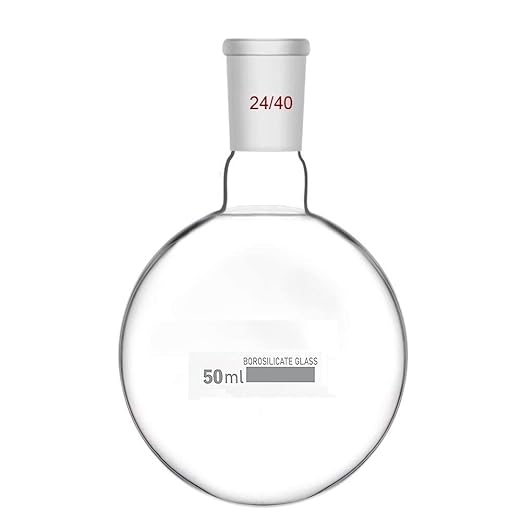
This 50ml borosilicate glass boiling flask with interchangeable joint is heat-resistant, durable, and ideal for precise distillation and boiling.
“Round Bottom Flask 2000 ML With joint b-24” has been added to your cart. View cart
Borosilicate Glass Round Bottom Boiling Flask with Inter Changeable Joint. 50 ML Capacity. Distillation Flask
₹299.00 Original price was: ₹299.00.₹199.00Current price is: ₹199.00.
Categories: laboratary glassware, Round bottom flask, Scientific Instruments
Description
The Definitive Guide to the Borosilicate Boiling Flask: Unmatched Performance for High-Temperature Reactions
Introduction to the Borosilicate Boiling Flask
A Borosilicate Boiling Flask is a fundamental piece of laboratory glassware. It is specifically engineered for heating liquids to their boiling point. This specialized laboratory flask is a cornerstone of chemical synthesis and analysis. Its design is optimized for efficient and safe boiling operations.
The use of borosilicate glass is the critical differentiator for this boiling flask. This material provides exceptional thermal shock resistance. This heat resistant property allows the flask to withstand rapid temperature changes. A Borosilicate Boiling Flask is essential for reliable high-temperature applications.
This flask typically features a spherical body and a long neck. The spherical shape promotes uniform heat distribution. It minimizes the risk of hot spots that can degrade sensitive compounds. The Borosilicate Boiling Flask is a versatile tool for many laboratory procedures.
It is indispensable for distillation, reflux, and evaporation setups. The chemical resistance of borosilicate glass ensures sample purity. Understanding the Borosilicate Boiling Flask is key to advanced laboratory work. This flask represents a perfect marriage of material science and functional design.
What is a Borosilicate Boiling Flask? A Detailed Definition
A Borosilicate Boiling Flask is a type of round bottom flask made from borosilicate glass. Its primary function is to contain liquids that need to be boiled or heated vigorously. The term “boiling flask” distinguishes it from other flasks used for storage or measurement.
The spherical bottom is designed for use with heating mantles. This allows for efficient transfer of heat into the liquid contents. The Borosilicate Boiling Flask often features a ground glass joint. This joint enables secure connection to condensers and other apparatus.
Its construction from borosilicate glass makes it superior to ordinary glass flasks. It can endure the thermal stress of direct heating much more effectively. This heat resistant quality is the flask’s most important attribute.
The Borosilicate Boiling Flask is also known as a reaction flask or round bottom flask. It is a workhorse in organic chemistry laboratories. This flask is designed for performance under demanding conditions.
The Anatomy of a Borosilicate Boiling Flask: Component Breakdown
The Spherical Body: The Core Heating Chamber
The spherical body is the most distinctive and functional feature of the Borosilicate Boiling Flask, serving as the central heating chamber in countless laboratory operations. Its carefully engineered round shape is not just aesthetic but highly practical, designed to maximize efficiency during heating, boiling, and distillation.
When placed in a heating mantle, the spherical body ensures that heat is applied evenly across the entire surface. Unlike flat-bottom vessels that may develop hot spots, the curved design distributes thermal energy uniformly, preventing localized overheating that could degrade sensitive samples or cause uneven reactions. This balanced heating allows chemists to maintain precise control over reaction conditions.
Another advantage of the spherical form is its ability to promote efficient mixing and circulation. As liquids are swirled or stirred inside, the absence of sharp corners minimizes turbulence, foaming, or splashing, making it ideal for controlled reactions. This smooth fluid motion ensures homogeneous mixing of reagents, improving the reproducibility of experimental results.
The spherical body must also withstand the internal pressure generated by boiling vapors. Here, the borosilicate glass construction plays a vital role. Known for its excellent thermal resistance, mechanical strength, and chemical durability, borosilicate glass prevents cracks or deformation even under rapid temperature changes. Its resistance to thermal shock is essential for laboratory environments where heating and cooling cycles are frequent.
Finally, the capacity of the spherical body defines the overall size of the boiling flask—ranging from small 50ml flasks for educational demonstrations to large multi-liter versions used in industrial-scale reactions. The choice of capacity allows laboratories to scale experiments according to their needs, while still benefiting from the same fundamental design advantages of the spherical form.
The Neck: The Access and Connection Point
The neck of the Borosilicate Boiling Flask is a cylindrical extension. It provides an opening for adding reagents and connecting to other glassware. The neck is often reinforced to provide structural strength. This is important when supporting additional apparatus.
Most boiling flasks have a single neck. However, multi-neck designs are available for complex setups. A two neck boiling flask allows for simultaneous attachment of a condenser and thermometer. The neck is where the ground glass joint is typically located.
The length of the neck helps to reduce evaporative losses. It also provides a safe distance between the boiling liquid and the connection point. The neck is a critical component of the flask’s overall functionality.
The Ground Glass Joint: For Secure Sealing
The ground glass joint is a key feature of a high-quality Borosilicate Boiling Flask. It consists of a precision-ground frosted glass surface. This creates a perfect seal with corresponding joints on other glassware. The joint is usually secured with a Keck clip or similar fastener.
This system provides an airtight and leak-proof connection. It is essential for vacuum distillations and closed-system reactions. The ground glass joint allows for modular assembly of complex laboratory setups.
Standard sizes ensure compatibility across different glassware brands. Common sizes for boiling flasks include 24/40 and 19/22 joints. The quality of the joint is vital for the safety and efficiency of the apparatus.
The Critical Role of Material: Why Borosilicate Glass is Essential
Superior Thermal Shock Resistance
Borosilicate glass is renowned for its low coefficient of thermal expansion. This gives the Borosilicate Boiling Flask exceptional thermal shock resistance. It can withstand temperature differentials of up to 165°C without cracking. This is its most critical property for a boiling flask.
This heat resistant quality allows the flask to be heated directly to high temperatures. It can also be cooled relatively rapidly without risk of breakage. This property is essential for repeated heating and cooling cycles.
Excellent Chemical Resistance and Inertness
A Borosilicate Boiling Flask must resist corrosion from aggressive chemicals. Borosilicate glass is highly inert to most acids, bases, and organic solvents. This chemical resistance ensures that the flask does not contaminate the reaction mixture.
The purity of the reactants and products is maintained. This is non-negotiable in analytical chemistry and pharmaceutical synthesis. The borosilicate glass provides a perfectly inert environment for chemical reactions.
Mechanical Durability and Strength
While still glass, borosilicate glass offers remarkable durability. It has higher mechanical strength than ordinary soda-lime glass. A Borosilicate Boiling Flask can withstand the physical stresses of daily laboratory use.
Its resistance to scratching and abrasion ensures a long service life. The durable nature of this flask makes it a cost-effective investment. Proper handling will ensure years of reliable performance.
Optical Clarity for Process Monitoring
The high transparency of borosilicate glass is a significant advantage. It allows visual monitoring of the reaction inside the boiling flask. Changes in color, phase, or boiling behavior can be observed in real-time.
This clarity is essential for controlling reaction progress and identifying endpoints. The transparent nature of the flask provides immediate feedback to the chemist. It is an essential feature for observational chemistry.
Types of Borosilicate Boiling Flasks
Single Neck Boiling Flasks
The single neck Borosilicate Boiling Flask is the most common type. It features one neck with a ground glass joint. This design is suitable for simple distillation and heating applications. It is the most versatile and widely used boiling flask.
This flask is ideal for setups requiring only one connection. It represents the standard configuration for a Borosilicate Boiling Flask.
Two Neck Boiling Flasks
A two neck Borosilicate Boiling Flask offers enhanced functionality. The additional neck allows for more complex apparatus assembly. One neck can accommodate a condenser while the other holds a thermometer or addition funnel.
This design is essential for reactions requiring monitored temperature control. The two neck boiling flask is a standard tool for advanced organic synthesis.
Three Neck Boiling Flasks
The three neck Borosilicate Boiling Flask provides maximum flexibility. It is the preferred choice for sophisticated multi-step reactions. The three necks can hold a condenser, thermometer, and addition funnel simultaneously.
This allows for precise control over all reaction parameters. The three neck boiling flask is essential for complex chemical transformations. It is the ultimate reaction flask for research and development.
Short Neck and Long Neck Variants
Borosilicate Boiling Flasks come with varying neck lengths. A short neck flask is more compact and stable when clamped. A long neck flask provides greater clearance above the boiling liquid. The choice depends on the specific application and apparatus setup.
Key Specifications for Selecting a Boiling Flask
Capacity: Choosing the Right Size
Borosilicate Boiling Flasks are available in a wide range of capacities. Common sizes include 50ml, 100ml, 250ml, 500ml, 1000ml, 2000ml, and 5000ml. Selecting the appropriate capacity is crucial for reaction efficiency and safety.
A good practice is to fill the boiling flask to no more than half its capacity. This provides sufficient headspace to prevent boiling over. The right size flask ensures optimal performance and safety.
Joint Size and Type: Ensuring Compatibility
The ground glass joint size is a critical specification. Standard sizes include 14/20, 19/22, and 24/40. The first number indicates the diameter in millimeters. The second number indicates the joint length.
All components in an apparatus must have matching joint sizes. Compatibility is essential for creating a secure, vacuum-tight system. The joint type must also be appropriate for the intended connections.
Wall Thickness and Glass Quality
The quality of the borosilicate glass significantly impacts performance. The glass should be free of bubbles, streaks, and inclusions. Uniform wall thickness ensures even heat distribution. This prevents thermal stress cracking during heating.
High-quality Borosilicate Boiling Flasks have fire-polished rims. This enhances safety and durability. The glass thickness should provide strength without excessive weight.
Primary Applications and Uses
Distillation Processes
The Borosilicate Boiling Flask is the standard container for distillation. It serves as the pot where the liquid mixture is heated. The heat resistant properties are essential for maintaining consistent boiling. Both simple and fractional distillation rely on this flask.
The spherical shape ensures even boiling and minimizes bumping. The boiling flask is a critical component of any distillation apparatus.
Chemical Synthesis and Reactions
As a reaction flask, it is used for conducting chemical syntheses. Its chemical resistance allows it to contain aggressive reactants. The heat resistant nature enables reactions to be carried out at elevated temperatures.
From simple esterifications to complex multi-step syntheses, this flask is central. It provides a safe and efficient environment for chemical transformations.
Refluxing for Controlled Heating
Reflux setups require a Borosilicate Boiling Flask to contain the reaction mixture. The flask is heated while connected to a condenser. This allows prolonged heating at the solvent’s boiling point without loss of material.
The heat resistant properties are crucial for maintaining reflux conditions. This technique is fundamental in organic synthesis.
Evaporation and Concentration
The Borosilicate Boiling Flask is used with rotary evaporators. The flask is rotated in a heated bath under reduced pressure. This rapidly evaporates solvents to concentrate solutions.
The spherical shape is ideal for creating a thin film of liquid. This maximizes the evaporation surface area. The flask’s durability withstands the mechanical stress of rotation.
Proper Usage and Handling Techniques
Correct Clamping and Support
A Borosilicate Boiling Flask requires proper support. Always use a clamp with coated jaws around the flask’s neck. Attach the clamp to a stable ring stand. Ensure the setup is secure before beginning heating operations.
Never allow the flask to support the weight of other apparatus. Proper clamping prevents accidents and breakage.
Heating with Appropriate Equipment
Always use a heating mantle designed for round bottom flasks. The mantle should match the flask size for efficient heat transfer. Never heat a Borosilicate Boiling Flask directly with a Bunsen burner. This creates dangerous hot spots.
The heat resistant properties are optimized for mantle heating. Gradual temperature changes are always recommended.
Safe Filling and Boiling Practices
Never fill the boiling flask beyond half its capacity. Leave ample headspace to prevent boiling over. Add boiling chips or a stir bar to promote even boiling. This prevents bumping and superheating.
When adding reagents, do so carefully to avoid splashing. Always be aware of the flask’s hot surface during operation.
Cleaning and Maintenance Procedures
Routine Cleaning Methods
Clean the Borosilicate Boiling Flask immediately after use. Rinse with an appropriate solvent to remove chemical residues. Wash with a laboratory detergent and a suitable brush. A final rinse with distilled water ensures no soap residue remains.
Allow the flask to dry completely before storage. Immediate cleaning prevents stubborn residue buildup.
Removing Stubborn Residues
For difficult residues, use specialized cleaning solutions. Chromic acid or commercial laboratory cleaners are effective. Always follow safety protocols when using aggressive cleaners.
The chemical resistance of borosilicate glass allows thorough cleaning. Never use abrasive materials that could scratch the glass surface.
Storage and Handling
Store Borosilicate Boiling Flasks in dedicated cabinets or racks. Use protective padding between flasks to prevent contact damage. Store with clamps loosened to avoid stress on the glass.
Inspect flasks regularly for cracks or chips. Remove damaged flasks from service immediately. Proper storage extends the life of your laboratory glassware.
Troubleshooting Common Issues
Thermal Stress Cracking
Cracking usually results from rapid temperature changes. Always heat and cool Borosilicate Boiling Flasks gradually. Avoid placing a hot flask on a cold surface. Use appropriate insulation when necessary.
The heat resistant properties have limits that must be respected. Proper heating techniques prevent thermal shock damage.
Ground Glass Joint Seizing
Joints can sometimes fuse together. Use high-temperature grease on joints when necessary. Avoid overtightening clips. If sticking occurs, try gentle heating or tapping.
Never force stuck joints as this can break the glass. Proper maintenance prevents joint seizing.
Boiling Over and Bumping
Overfilling is the most common cause of boiling over. Always maintain proper headspace. Use boiling chips or stirring to prevent bumping. Control heating rates to maintain gentle boiling.
These practices ensure safe and efficient operation of your boiling flask.
The Future of Borosilicate Boiling Flasks
Advanced Material Developments
Research continues into enhanced glass formulations. Future Borosilicate Boiling Flasks may offer even greater thermal shock resistance. Non-stick coatings could improve cleaning and prevent residue adhesion.
These advancements will further enhance the performance of this essential tool.
Integration with Automated Systems
Modern laboratories are rapidly adopting automation to improve efficiency, accuracy, and reproducibility. Borosilicate Boiling Flasks are now being designed and manufactured with features that make them compatible with robotic arms and automated liquid-handling platforms. Their uniform wall thickness, precise joint dimensions, and high thermal stability allow seamless operation in automated setups without risk of breakage or leakage.
As integration with automated reaction systems continues to evolve, these flasks will play a critical role in enabling high-throughput chemistry, where multiple reactions can be performed simultaneously under controlled conditions. This advancement not only accelerates process optimization but also reduces human error, increases data reliability, and supports continuous flow chemistry in research and industrial laboratories.
Future innovations may include smart flasks with embedded sensors to monitor temperature, pressure, and reaction progress in real time, further enhancing their compatibility with digital laboratory management systems.
Conclusion: The Indispensable Laboratory Tool
The Borosilicate Boiling Flask represents a perfect synthesis of material science and functional design. Its borosilicate glass construction provides unmatched thermal shock resistance and chemical resistance. These properties make it indispensable for high-temperature laboratory applications.
From teaching laboratories to industrial production facilities, this flask remains essential. Its durability, clarity, and performance characteristics are unmatched. The Borosilicate Boiling Flask will continue to be a fundamental tool for chemical research and production.
Mastering its use is essential for any practicing chemist. This iconic piece of laboratory glassware embodies the precision and reliability of modern chemical science. Its continued evolution will support scientific advancement for years to come.
Be the first to review “Borosilicate Glass Round Bottom Boiling Flask with Inter Changeable Joint. 50 ML Capacity. Distillation Flask” Cancel reply
Related products
-
Sale!

KAUSHIK INDIA 20ML 50Pcs Borosilicate Glass Vial With Screw Cap, Leak Proof Liquid Storage Vial For Essential Oil,Perfume,Meds,Reagent,Anointing Oil Bottle And Lab Use Culture Tube
₹960.00Original price was: ₹960.00.₹759.00Current price is: ₹759.00. -
Sale!
Borosilicate 3.3 Glass Measuring Cylinder with Graduation Marks for Measuring of Liquids 2000 ML
₹2,599.00Original price was: ₹2,599.00.₹1,499.00Current price is: ₹1,499.00. -
Sale!
Borosilicate Glass Funnel 3 inches 75mm for Laboratory Use Borosilicate Glassware for Bottle Hot Oil or Liquid Chemicals Solutions Suitable for lab, food, and DIY projects
₹169.00 – ₹499.00Price range: ₹169.00 through ₹499.00Select options This product has multiple variants. The options may be chosen on the product page Details
Reviews
There are no reviews yet.