
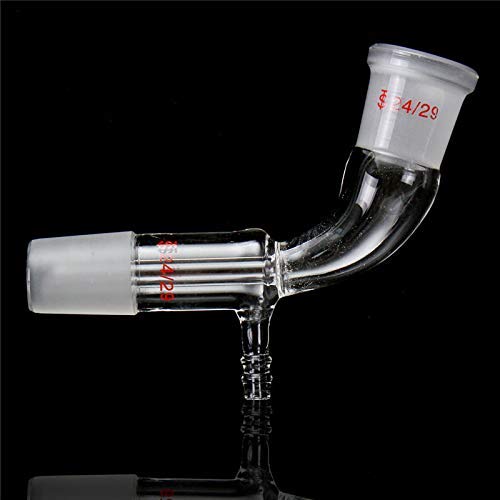
Premium borosilicate glass vacuum distillation adapter designed for durability, heat resistance, and leak-free performance.
Borosilicate Glass Bend Connector Tube Vacuum Distillation Take Off Adapter Borosilicate Glass Laboratory Chemical Equipment (B-24, Standard)
Original price was: ₹1,999.00.₹617.00Current price is: ₹617.00.
Description
The Ultimate Guide to the Vacuum Distillation Adapter: Engineering Precision for Separation Science
Introduction to the Vacuum Distillation Adapter
The vacuum distillation adapter is a critical component in advanced laboratory setups.
It is a specialized piece of laboratory glassware designed for one purpose: to enable distillation under reduced pressure.
This device is not a standalone instrument but a connecting module.
It integrates various parts of a vacuum distillation apparatus.
The vacuum distillation adapter makes complex separations possible.
It allows chemists to distill heat-sensitive compounds that would decompose at their normal boiling points.
This technique is essential in organic chemistry, perfume manufacturing, and petrochemical refining.
The adapter is a masterpiece of glassblowing and functional design. vacuum distillation adapter
Understanding its role is key to mastering vacuum distillation techniques.
It is a symbol of precision and control in the chemical laboratory. vacuum distillation adapter
What is a Vacuum Distillation Adapter?
A vacuum distillation adapter is a custom-shaped glass component.
It is specifically designed to form a sealed connection within a distillation apparatus.
This connection is made under vacuum conditions.
The adapter typically features multiple standard taper joints. vacuum distillation adapter
These joints, often 24/40 or 29/32, provide an airtight seal.
It also includes one or more specialized ports or outlets.
The most common type is the vacuum distillation adapter with thermometer port.
This allows for the precise monitoring of vapor temperature during distillation.
Another key feature is the vacuum inlet.
This is a sidearm or port that connects to the vacuum source.
The entire unit is crafted from high-quality borosilicate glass.
This ensures it can withstand thermal stress and chemical corrosion.
Key Features and Specifications of a Vacuum Distillation Adapter
The performance of this specialized adapter is defined by its specific features.
Each element is meticulously designed for function and safety.
Standard Taper Joints (STJs)
The standard taper joint is the heart of the adapter’s connectivity.
These precision-ground glass joints provide a perfect, leak-free seal.
Common sizes include 14/20, 19/22, 24/40, and 29/32.
The first number is the diameter (in mm) of the large end of the inner joint.
The second number is the length (in mm) of the joint.
The vacuum distillation adapter will have at least two of these joints.
One connects to the distillation flask or Claisen adapter.
The other connects to the condenser or receiving adapter.
The perfect seal is crucial for maintaining a high vacuum.
Thermometer Port and Thermometer Well
A vacuum distillation adapter with thermometer port is the most common type.
This port is a dedicated opening for a laboratory thermometer.
It is often designed as a thermometer well.
This well is a glass sleeve that protrudes into the vapor path.
The thermometer does not touch the glass walls inside this well.
This ensures an accurate reading of the vapor temperature, not the glass temperature.
The position is critical; the bulb must sit just below the sidearm outlet.
This allows it to measure the temperature of the vapors entering the condenser.
Vacuum Inlet Sidearm
This is a defining feature of the vacuum distillation adapter.
It is a tubular sidearm projecting from the main body of the adapter.
This sidearm is connected via heavy-wall tubing to the vacuum source.
It is the point where vacuum is applied to the entire system.
The placement of this inlet is strategic.
It is located after the thermometer port but before the condenser joint.
This ensures an even pressure drop across the entire apparatus.
The sidearm often has a hose barb or another standard taper joint for connection.
Material and Construction: Borosilicate Glass
The adapter is exclusively made from borosilicate glass 3.3.
This material is chosen for its exceptional properties.
It has a very low coefficient of thermal expansion.
This grants it superb thermal shock resistance.
The adapter can withstand the temperature gradients of vacuum distillation.
Borosilicate glass is also highly chemically resistant.
It is inert to virtually all organic solvents, acids, and bases.
This prevents contamination of sensitive distillates.
The glass is also transparent, allowing visual monitoring of the process.
Design and Angle of the Adapter
The vacuum distillation adapter is not a straight connector.
It is typically designed at a specific angle, often 75 or 105 degrees. vacuum distillation adapter
This angle is crucial for directing the vapor flow efficiently.
It ensures that the distilled vapors turn smoothly into the condenser.
This minimizes pressure drop and prevents “bumping” or violent boiling.
The design also ensures that any liquid condensate flows correctly.
It prevents flooding or backflow into the distillation flask.
The Critical Role in Vacuum Distillation
The vacuum distillation adapter is the central hub of the operation.
It performs several simultaneous, critical functions.
Creating and Maintaining the Vacuum Seal
The primary role is to provide a sealed connection.
It links the boiling flask to the condenser under vacuum.
Its standard taper joints, when greased properly, create an airtight seal.
This is absolutely mandatory for maintaining reduced pressure.
Any leak will compromise the vacuum and ruin the distillation.
The adapter is the keystone that holds the entire sealed system together.
Enabling Accurate Temperature Monitoring
The vacuum distillation adapter with thermometer port is essential for control.
In vacuum distillation, boiling points are depressed.
The observed boiling point is a function of the applied vacuum.
Therefore, monitoring the vapor temperature is the only way to track the process.
It allows the chemist to identify when the desired fraction is distilling over.
This is critical for separating compounds with close boiling points.
Without this adapter, temperature monitoring would be inaccurate or impossible.
Providing a Port for Vacuum Application
The adapter’s sidearm is the dedicated entry point for vacuum.
It provides a secure and stable connection for the vacuum hose.
This design centralizes the vacuum input.
It prevents the need for multiple taps on different pieces of glassware.
This simplifies the setup and reduces potential leak points. vacuum distillation adapter
Facilitating the Collection of Fractions
Some vacuum distillation adapters are designed for fraction collection.
A distillation adapter may have a multi-way outlet.
This allows it to be connected to a receiving flask or a fraction collector.
The chemist can then rotate the adapter to direct distillate into different flasks.
This is essential for separating a mixture into its pure components.
Types of Vacuum Distillation Adapters
There are several designs, each tailored for specific distillation setups.
Standard Vacuum Distillation Adapter (with Thermometer Port)
This is the most common and classic design.
It features a male standard taper joint on the bottom for the flask.
A female standard taper joint on the end for the condenser.
A thermometer port on top.
And a vacuum inlet sidearm.
It is the workhorse for most standard vacuum distillation setups.
Claisen Adapter
The Claisen adapter is a specialized type of distillation adapter.
It features a Y-shaped design with two vertical openings.
One opening is for a thermometer or a capillary bubbler (for anti-bumping).
The other opening connects to the distillation flask.
The sidearm is for the vacuum inlet.
The bottom connects to the condenser.
It is used when an additional port is needed for introducing boiling chips or a gas.
Distilling Head with Cow Receiver
This is a more complex adapter for advanced fraction collection.
It looks like a standard vacuum distillation adapter but with a circular cow.
The cow has multiple outlet ports pointing downward.
Each port can hold a receiving flask.
The entire cow can be rotated to direct the distillate into different flasks.
This allows for the collection of multiple fractions without breaking vacuum.
Cold Finger Adapter
For microscale or specialized distillations, a cold finger adapter is used.
It integrates a condenser directly into the adapter body.
A “cold finger” filled with coolant (like dry ice) is inserted into the vapor path.
This causes immediate condensation without a separate condenser unit.
It is highly efficient for small volumes and high-boiling point materials.
The Science of Vacuum Distillation
Understanding the theory highlights the adapter’s importance.
Principles of Reduced Pressure Distillation
Applying vacuum lowers the pressure inside the system.
This significantly lowers the boiling points of the compounds inside.
A compound that boils at 300°C at atmospheric pressure might boil at 150°C under high vacuum.
This allows for the distillation of thermally unstable compounds.
It prevents decomposition and cracking that would occur at high temperatures.
The Role of the Adapter in the System
The vacuum distillation adapter sits at the highest point of the vapor path.
Vapors rise from the boiling flask and enter the adapter.
They pass by the thermometer bulb, which records their temperature.
The vacuum applied through the sidearm pulls the vapors through.
The vapors then exit the adapter and enter the condenser to be liquefied.
The adapter is the critical transit point for all vapors.
Proper Usage and Technique
Correct assembly and use are paramount for success and safety.
Assembly and Greasing Joints
Assemble the vacuum distillation apparatus carefully.
Apply a thin, even layer of vacuum grease to all standard taper joints.
This ensures a perfect seal and allows for easy disassembly later.
Connect the adapter to the distillation flask first.
Then insert the thermometer into the thermometer well.
Connect the vacuum hose to the sidearm securely using a spring clip.
Finally, connect the condenser to the outlet of the adapter.
Applying Vacuum and Monitoring
Before heating, always start the vacuum source.
This could be a vacuum pump or a water aspirator.
Allow the system to reach its stable, desired pressure.
Then, begin applying heat to the distillation flask gradually.
Monitor the vapor temperature closely through the adapter’s port.
Collect distillate when the temperature stabilizes at the expected range.
Safety Considerations
Vacuum distillation involves significant hazards.
The vacuum distillation apparatus is under negative pressure.
Implosion is a risk if there are flaws in the glass.
Always use a blast shield or safety screen.
Never use scratched or chipped glassware.
Be aware that a loss of vacuum can cause hot fluid to be sucked back.
Always use a trap between the apparatus and the vacuum pump.
Cleaning and Maintenance
Proper care ensures the longevity of this precision instrument.
Cleaning After Use
Disassemble the vacuum distillation adapter immediately after it cools.
Rinse it with an appropriate solvent to dissolve residues.
Soak it in a warm laboratory detergent solution.
Use a soft brush to clean the interior and the thermometer well.
Rinse thoroughly with tap water followed by distilled water or acetone.
Inspecting for Damage
Before each use, inspect the adapter meticulously.
Check for any star cracks, chips, or scratches, especially on the standard taper joints.
Inspect the thermometer well for integrity.
A damaged adapter cannot hold a proper vacuum and is a safety hazard.
Never use compromised glassware.
Safe Storage
Store the vacuum distillation adapter in a dedicated cabinet.
Use a storage rack that supports its unusual shape.
Avoid placing any weight on top of it to prevent stress on the joints and sidearm.
Troubleshooting Common Issues
Even experienced chemists encounter problems.
Problem: Inability to Hold Vacuum
Solution: The most common cause is poorly greased or damaged standard taper joints. Regrease all joints. If the problem persists, submerge the assembled apparatus in water and look for bubbles to find the leak. Replace any damaged components.
Problem: Erratic Temperature Readings
Solution: Ensure the thermometer bulb is positioned correctly in the thermometer well. It should not be touching the glass. Also, ensure the thermometer well itself is not flooded with condensate.
Problem: Bumping and Violent Boiling
Bumping occurs when a liquid in a distillation flask overheats and boils irregularly, releasing sudden bursts of vapor. This violent boiling not only disrupts smooth distillation but can also send liquid into the condenser and adapter, contaminating the distillate and risking glassware damage.
Likely Causes:
-
-
Lack of Nucleation Sites
In distillation and other heating processes, smooth glass surfaces and highly pure liquids present a unique challenge. Normally, bubbles form at tiny imperfections or microscopic rough spots in the container walls, known as nucleation sites. These sites act as starting points for vapor formation, allowing boiling to occur in a controlled, steady manner.
When nucleation sites are absent, the liquid can become superheated—its temperature rises above the normal boiling point without forming bubbles. This creates a dangerously unstable condition. At some unpredictable moment, vapor will suddenly form in large quantities, resulting in violent bumping or explosive boiling. This not only disrupts the distillation process but can also damage glassware, cause sample loss, or even pose a safety hazard to the operator.
-
-
Overheating: Excessive heat input without agitation encourages violent vapor surges.
-
Absence of Stirring Mechanism: Without boiling chips, granules, or agitation, liquids remain superheated until abrupt vapor release occurs.
Solutions:
-
Add Boiling Chips or Anti-Bumping Granules – Introduce a few inert granules before heating begins. These provide nucleation sites, allowing vapors to escape steadily and preventing sudden surges.
-
Use a Claisen Adapter with a Capillary Bubbler – A fine stream of air introduced through the capillary creates continuous nucleation points, ensuring smooth boiling throughout the process.
-
Magnetic Stirring (If Applicable) – In setups with magnetic stir bars, constant agitation helps distribute heat evenly and prevents localized overheating.
-
Control Heating Rate – Apply gentle, incremental heating rather than sudden high temperatures to maintain steady vapor formation.
-
Avoid Adding Chips Mid-Process – Always add boiling chips before heating begins. Adding them to a hot liquid can trigger splashing or sudden eruptions.
Pro Tip: For long distillations under vacuum, a capillary bubbler setup is often more reliable than boiling chips alone, since granules may lose effectiveness after extended runs.
Problem: Flooding of the Adapter
Flooding is a common issue in vacuum distillation setups and can significantly disrupt separation efficiency. It occurs when liquid enters the adapter instead of remaining confined to the boiling flask and condenser system.
Likely Causes:
-
Excessive Heating: Applying too much heat causes uncontrolled, vigorous boiling. This produces large vapor surges that overwhelm the condenser and force liquid into the adapter.
-
Overpowered Vacuum: A vacuum that is too strong lowers the boiling point excessively, leading to violent bumping and rapid vapor formation vacuum distillation adapter.
-
Insufficient Condensation: If the condenser is not cooling efficiently, vapors may pass through as liquid droplets, contributing to flooding.
Solutions:
-
Reduce Heat Input – Gradually lower the heating source to establish steady, controlled boiling. A gentle boil ensures vapors condense properly without overwhelming the system.
-
Adjust Vacuum Pressure – If possible, slightly reduce vacuum strength to moderate the boiling rate. A controlled vacuum prevents bumping and minimizes liquid carryover.
-
Check Condenser Efficiency – Ensure cooling water flow is steady and cold enough to condense vapors fully before they reach the adapter.
-
Use Anti-Bumping Granules or a Magnetic Stirrer – This promotes smooth boiling and reduces sudden surges that cause flooding.
Pro Tip: Always aim for a balanced distillation rate—fast enough for efficiency, but slow enough to maintain control. A steady drip at the adapter outlet is ideal, while splashing or continuous liquid streams often signal flooding problems.
Conclusion: The Indispensable Hub of Precision Distillation
The vacuum distillation adapter is a masterpiece of chemical engineering in glass.
It is far more than a simple connector; it is the intelligent core of the distillation apparatus.
It seamlessly integrates temperature monitoring, vacuum application, and vapor transfer into a single, coherent unit.
Its design, from the standard taper joints to the angled vacuum inlet, is the result of decades of refinement.
This specialized adapter enables one of chemistry’s most powerful purification techniques: vacuum distillation.
It allows scientists to manipulate the physical world, gently separating delicate compounds that would otherwise be destroyed.
Its role in research, pharmaceutical development, and essential oil extraction is irreplaceable.
The vacuum distillation adapter stands as a testament to the fact that the most critical components are often those that enable control and measurement.
It is an indispensable, precision instrument that sits at the very heart of separation science.


Reviews
There are no reviews yet.